
Budding talent: Achieving management zen through ikebana flower arrangement
Ikebana, the Japanese art of flower arrangement, holds timeless lessons for harmonious management and personal growth. Mayuka Yamazaki explains how.

Humans鈥� relationship with nature is often defined by domination, on the one hand, and idealism, on the other. Recent interest in the practice of mindfulness has tended to focus on the latter, with studies highlighting the links between mental health and access to nature: the sound of birdsong reduces depression; greenery is good for you.
But more than simply being decorative, the natural world, like the human world, consists of individuals, each with special attributes and functions. Gardeners have long combined different plants to create harmonious ecosystems and keep flowers blooming throughout the year. It鈥檚 not much of a stretch to apply this metaphor to business management.
Tokyo native Mayuka Yamazaki certainly saw the parallels throughout her studies and subsequent career as a management consultant with McKinsey and with Harvard Business School鈥檚 Japan Research Center. She has always devoted her free time to practicing ikebana, the traditional Japanese art of flower arrangement. Her longstanding love of ikebana and her belief in its relevance for leaders led her to found , an initiative which brings the spirit and essence of ikebana to business and education. To be closer to nature, she recently moved to Karuizawa, a picturesque town in the mountains, though she maintains a studio in Tokyo, where she offers ikebana workshops several times a month.
 Mayuka Yamazaki: 鈥淥ur role as humans is to see the beauty in nature, and let it emerge.鈥� CREDIT: Yasunobu Tamari
Room to grow
鈥淎t the core of ikebana is the notion of letting flowers live,鈥� she says. 鈥淲e don鈥檛 force them to align with what we want to create. Instead, a human observes the beauty and flow of each flower and lets the flower shine and live as it is. Our role as humans is to see the beauty in nature, and let it emerge. To let each natural piece in the arrangement work to the best of its potential, we must approach it with openness and a willingness to listen.鈥�
This is similar to some of the tenets of mindfulness, which encourages people to clear their minds and tune into the moment.
鈥淚t鈥檚 like managing a person,鈥� she explains. 鈥淓mployees perform better when they are treated as unique individuals. If you approach people with a preset idea, you may feel frustrated when their behavior deviates from your expectations. But if you accept people as they are, you can tap into their real potential.鈥�
The leader as master arranger
Ikebana is learned over many years. Students practice under masters who have dedicated their lives to the art form. The new learners move up through all levels of expertise to eventually qualify as masters themselves. But the master-student relationship is not entirely one of instruction.
Instead, masters teach basic principles, introducing the three major elements of line, mass and color, which are arranged on a spiked plate (kenzan) within a shallow vase or box. Botanical elements 鈥� not only flowers but also branches, leaves, roots, grasses and stems 鈥� are arranged according to various schools of ikebana and principles derived from Buddhism and Confucianism.
Beyond these pointers, masters don鈥檛 tell their students what to do. Instead, learners work with their materials to create artistic arrangements, and the master provides feedback. The feedback relates not only to technique but also to mindset. It鈥檚 a true master-apprentice model. And although Yamazaki sometimes has issues with the hierarchy 鈥� she doesn鈥檛 let her students call her 鈥渕aster鈥� 鈥� the practice itself is something of a leveler. 鈥淲e are all equal in front of the flowers,鈥� she says. Put another way, the work will speak for itself.
Indeed, too much of a 鈥渕anager mindset鈥� can be destructive. In ikebana, 鈥測ou are an observer first and then a creator.鈥� The creation stems from the observation, through finding the right length, angle and placement for each element of the arrangement. Too much ego, Yamazaki insists, prevents you from really looking and seeing the innate characteristics of each plant. And rather than seeing their limitations and imperfections, ikebana practitioners need to see the possibilities inherent in each living thing.
The kindest cut
Western flower arranging prioritizes a tight, full bouquet, in contrast with the Japanese tradition, which is more minimalist and features much more empty space. The philosophy is that each flower needs space to come into its own. Giving it that space is part of the artistic practice. 鈥淩emoving or simplifying things is very important to create the flow,鈥� Yamazaki says.
Sometimes the process of subtraction is fraught. When it comes to pruning branches to create a cleaner line, for instance, it takes courage to make that decisive cut. But the beauty is in the simplicity.
This also teaches the ikebana practitioner to take responsibility. If you cut too much, you can鈥檛 go back. And according to ikebana philosophy, you shouldn鈥檛 dwell on it, because that isn鈥檛 living in the moment, ever-changing and mutable. 鈥淚t affects your mindset. Making mistakes is learning to live with what you have done.鈥�
The miracle of each moment
Ikebana presents a paradox. The word itself means 鈥渓etting flowers live,鈥� yet cut flowers are destined to wither and are already on the road to death. Is there value in this impermanence?
Yamazaki ties it back to the Japanese idiom ichi-go ichi-e, literally meaning 鈥渙ne time, one meeting.鈥� It emphasizes that no moment in life can be repeated, so every meeting should be cherished. This is even more evident when observing flowers.
鈥淓very moment is precious and will not come again. If you accept this, every moment is a miraculous encounter. And each is different. The way I look at a flower now is different from how I will see it in five minutes. One is not better than the other, although each might lead me in a different creative direction.鈥�
鈥淏ut the idea that each encounter is miraculous goes deeper than ikebana. This kind of thinking affects how you see other people. It means that every action is a chance to connect with people, society and the world more deeply. You start to see the world more beautifully.鈥�
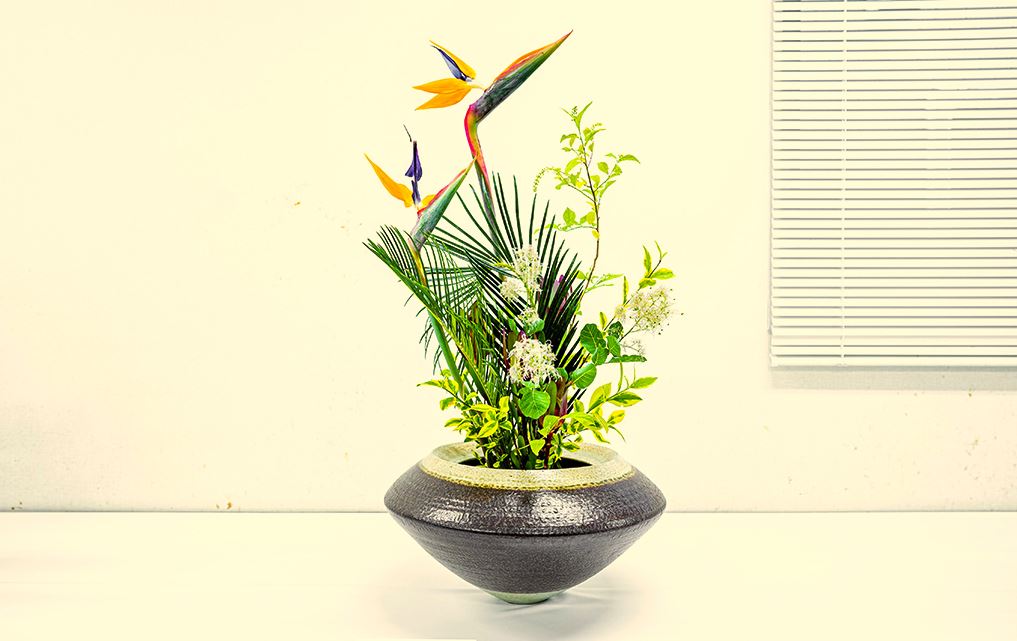 Mayuka Yamazaki鈥檚 own ikebana arrangement from the IKERU Exhibition 2022. CREDIT: Yasunobu Tamari
Learning from nature
While the workplace can benefit from ikebana鈥檚 in-the-moment philosophy, which feeds into mindfulness techniques that have been shown to boost creativity and performance, the world of ikebana is changing.
There are different schools 鈥� one more rigid and hierarchical, one more creative and favoring improvisation. Yamazaki leans toward the creative option, prioritizing getting outside to source materials in the beauty of nature.
鈥淚 believe that this more nature-centered approach is appropriate to business today, though 50 years ago the more rigid approach might have been more applicable. But nowadays we know that we must promote conversation and dialogue, and value our employees.鈥�
She adds, 鈥淧eople who work in organizations must not be seen just as tools for reaching goals. You need to let them bloom.鈥�
Ferns, rhodies, cardamines, lend me your ears!
鈥淥n the basis of decades of experiments, plants are starting to be regarded as beings capable of calculation and choice, learning and memory,鈥� Stefano Mancuso, Italian botanist and plant intelligence advocate, has written.
So, would plants like classical music? We don鈥檛 know conclusively, but this didn鈥檛 prevent conceptual artist Eugenio Ampudia from mounting when Barcelona鈥檚 famous opera house reopened in mid-2020 after months of lockdown during the coronavirus pandemic.
A string quartet performed Puccini鈥檚 鈥淐risantemi鈥� for an audience not of people (social mixing was still extremely limited) but of 2,292 plants arranged in the Liceu鈥檚 red velvet seats. The project was suggested to Ampudia during lockdown when, as humans withdrew from the outside world, plants flourished and birdsong was once more heard everywhere, even in the city center.
The Liceu project reflected on the relationship between humans and nature 鈥� how essential it is for our survival but also how fragile 鈥� and sprang from the artist鈥檚 desire to give the plants 鈥渢he best of what we are.鈥�
After the concert, the plants were distributed among the pandemic鈥檚 frontline healthcare workers. As the Liceu鈥檚 artistic director (天美传媒 PDG 2016) described it: 鈥淎 powerful and poetic action. It鈥檚 time for humanity to wake up!鈥�
A version of this article is published in 天美传媒 Insight #164.

|

|

|

|

|